
On Amazon, 80% of negative reviews for bags are not about style—they are about failure. “The strap snapped after one week,” “The zipper broke on my trip,” or “The dye stained my white shirt.”
In the world of B2B manufacturing, a beautiful sample is not enough. You need a durable product that can survive the real world. This is why “Physical Testing” is the unsung hero of brand reputation.
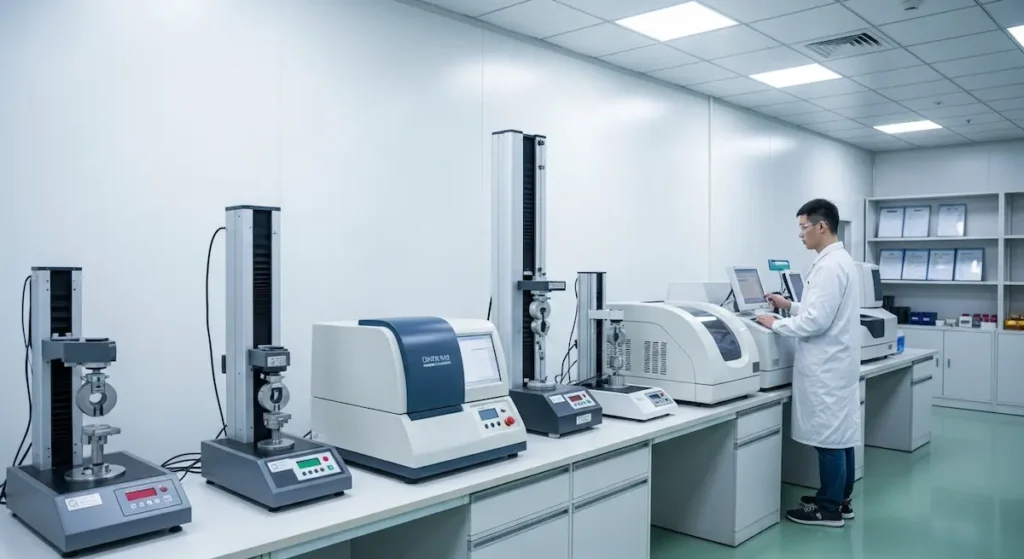
At TIMMY, we don’t just hope your bag holds up; we prove it. We have an in-house physical testing lab where we torture-test our products before mass production. Here are the 5 critical tests every reliable OEM bag must pass.
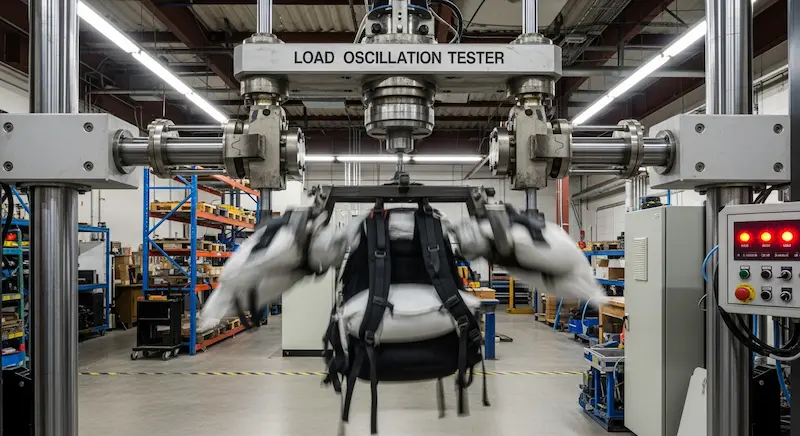
1. Load Oscillation Test (The “Jerk” Test)
The Problem: When a user walks or runs with a backpack, the load bounces up and down, creating dynamic stress on the shoulder straps far greater than the static weight of the contents.
The Test: We load the bag with standard weights (e.g., 10kg or 20kg). The bag is hung on a machine that lifts and drops it repeatedly (oscillates) for 400 to 1,000 cycles.
Pass Criteria: No stitching can break, no fabric can tear, and the strap adjusters must not slip. This ensures your custom backpack won’t fail during a commute.
2. Zipper Reciprocating Test (The “Fatigue” Test)
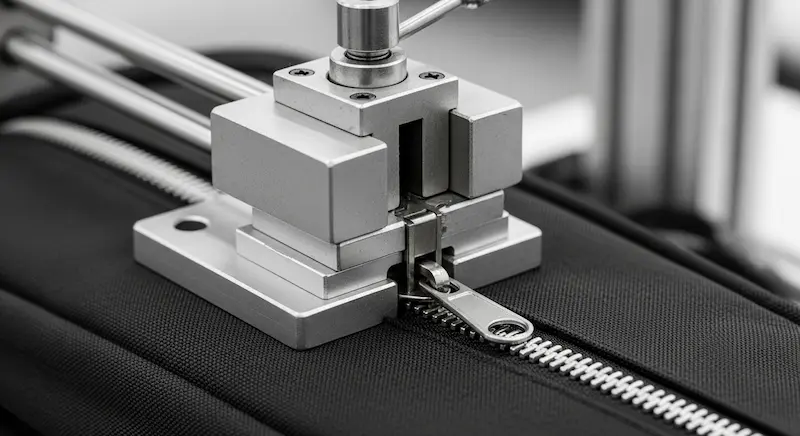
The Problem: Zippers are the most complex mechanical part of a bag. If the teeth misalign or the slider wears out, the bag is useless.
The Test: A machine grips the zipper puller and aggressively zips it open and closed, back and forth, for 500 to 3,000 cycles at a constant speed.
Pass Criteria: The zipper must still operate smoothly, and the teeth must not show significant wear. This is why we insist on quality brands like YKK or SBS (see our Hardware Guide).
3. Color Fastness to Rubbing (The “White Shirt” Test)
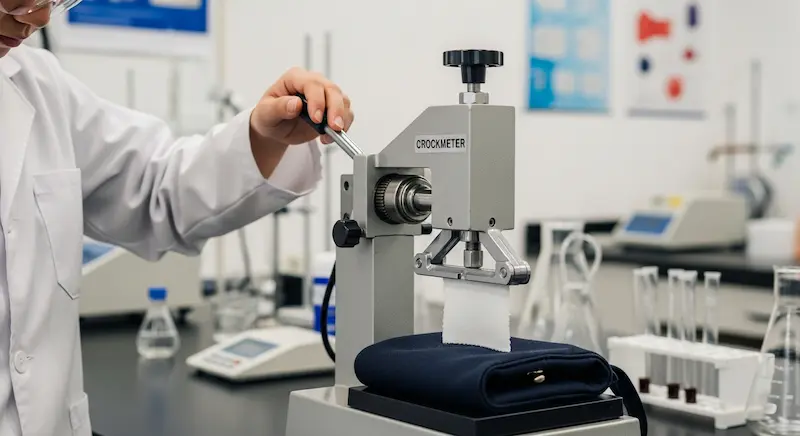
The Problem: A customer buys your navy blue canvas tote. They wear it with a white t-shirt. It rains. The blue dye rubs off onto their shirt. This creates angry customers.
The Test (Crockmeter): We use a machine called a Crockmeter. It rubs a standard white cotton cloth back and forth against your bag’s fabric 10 times with a specific pressure. We do this twice: once Dry, once Wet.
Pass Criteria: We check the white cloth. If it picked up significant color (graded on a Grey Scale of 1-5), the fabric fails. We aim for Grade 4-5 (no transfer).
4. Seam Strength Test (Tensile Strength)
The Problem: If the needle is too big, it cuts the fabric fibers. If the stitch density is too low, the seam gapes open under pressure.
The Test: We cut a strip of the sewn seam and clamp it into a tensile testing machine. The machine pulls it apart until it rips. We measure the force (in Newtons) required to break it.
5. Drop Test
The Problem: Shipping is rough. Bags get thrown. If a buckle is brittle, it will shatter on impact.
The Test: We load the bag to its maximum capacity and drop it from a height (usually 1 meter) onto a hard surface multiple times on different sides.
Conclusion: Tested for Trust
Physical testing is the difference between a “cheap import” and a “reliable brand.” By performing these tests in-house at TIMMY, we catch potential failures before they leave the factory floor.
Don’t gamble with your quality. Partner with a manufacturer that verifies every stitch. Contact us to see our lab reports.