

A quotation is most useful when you can see which design, material, quantity and packing assumptions it covers. If the price is above your target, compare alternative specifications before making trade-offs.
Understanding the main cost drivers helps you ask better questions and compare quotations on the same basis. A lower unit price is not a saving if it removes a feature your customer needs.
Use this guide to discuss design-to-budget options with Timmy Bags. Any cost change must be confirmed by a project quotation; there is no fixed saving percentage that applies to every bag.
1. Understand the Main Cost Drivers
The cost balance varies with the design and order. Common cost drivers include:
- Materials: Fabric, lining, zippers, buckles, foam, packaging.
- Production work: Cutting, sewing, finishing, QC. This is calculated based on time.
- Overhead and margin: Electricity, rent, machine maintenance, and margin.
Review material and construction alternatives while keeping the agreed quality, function and compliance requirements.
2. Material Yield: The Hidden Cost of Waste
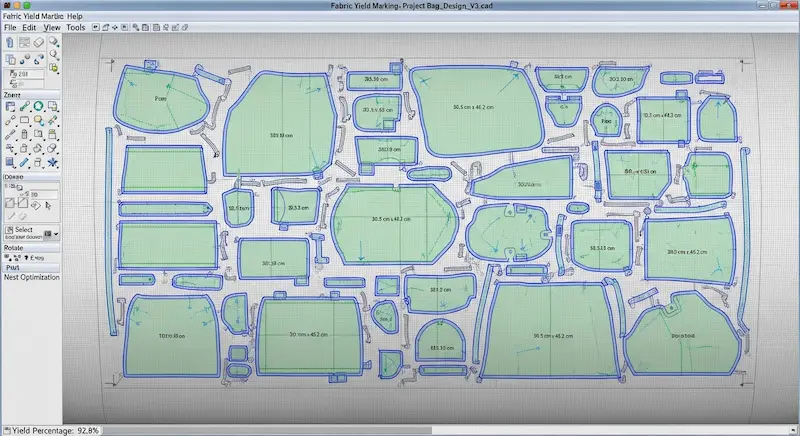
Cutting efficiency depends on the actual fabric width, panel shapes, grain direction, print placement and required matching. Ask for a layout-based comparison rather than assuming a standard waste allowance.
Compare the actual pattern: Curves, directional prints and repeated panels can change fabric usage. A rectangular shape is not automatically the best commercial choice if it weakens the product’s purpose.
Design question: Can the same function be achieved with fewer panels or a different construction? Review the sample and revised quotation before accepting a change.
3. Construction Complexity and Production Work
Construction time depends on the operation, material, equipment and production method. A generic number of minutes per pocket or seam is not a reliable quote for your design.
Examples of features to review include:
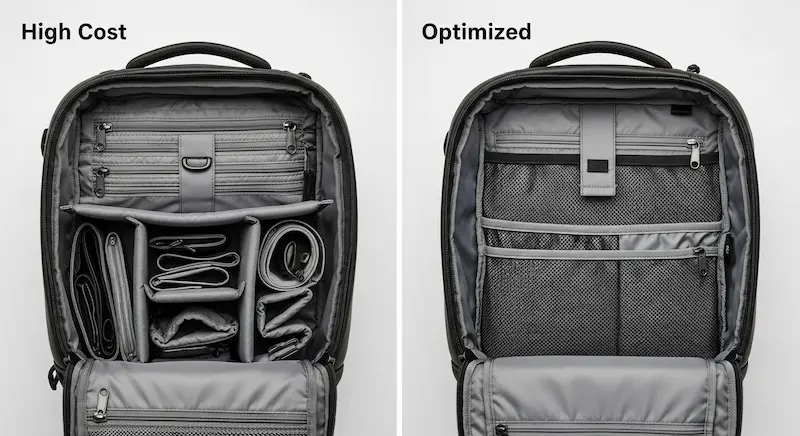
- Zipper pockets and their finishing.
- Internal seam binding and edge finishing.
- Organizer panels, dividers and attachments.
Ask which operations contribute most to the quoted price. Consider their value to the customer before removing a pocket, divider or reinforcement. Any expected saving should be separately quoted.
4. Order Quantity and Setup
Order quantity and color allocation can affect setup and material sourcing. Larger orders do not automatically receive the same percentage discount.
Development and setup requirements vary by project and can include:
- Sample making and pattern grading.
- Project-specific development and setup.
- Machine setup and line arrangement.
- Dyeing vats (if you want a custom Pantone color).
Timmy’s standard MOQ is 500 pieces. For one style in multiple colors, the minimum is 300 pieces per color across at least 3 colors (900 pieces total). Sample costs depend on complexity and are quoted before sampling begins.
Conclusion: Design for Price
State the target budget alongside your must-have functions, branding and delivery destination. Compare quotations with the same material, quantity, packing and delivery basis.
Send your design and target budget to discuss practical options. Timmy Bags responds within 24 hours; a complete quotation depends on the confirmed project details.